
“Learn AI” is an unhelpfully large career assignment. It could mean developing models, checking a generated report, organizing messy information, or knowing when a tool is unsuitable. You need a narrower goal that fits the work you want to do.
For a nontechnical worker, a useful starting point is one small work sample showing how you reach a reliable result. The sample should make your judgment visible: what you asked the tool to do, what you checked, what you changed, and what you refused to assume.
Read skills research with its limits attached
The OECD's 2024 analysis of AI exposure and skills demand found management and business skills prominent in highly exposed occupations. It examined online vacancies across ten OECD countries, rather than providing a live list of today's most requested skills. Its findings also vary by analytical approach, including evidence that demand for some skills may be falling within more exposed establishments.
The OECD's June 2026 skills brief highlights digital capability, data analysis and interpretation, problem-solving, and managerial skills. It also warns that early signals about social-skill demand are mixed. Treat broad claims that communication or creativity will always protect a career cautiously.
An August 2026 joint skills report hosted by the ILO likewise emphasizes AI literacy and the ability to use tools safely and ethically. That supports treating evaluation and responsible use as part of the learning goal.
These findings suggest useful areas to investigate. Your target roles and clients should determine which one you practice first.
Start with a small demand check
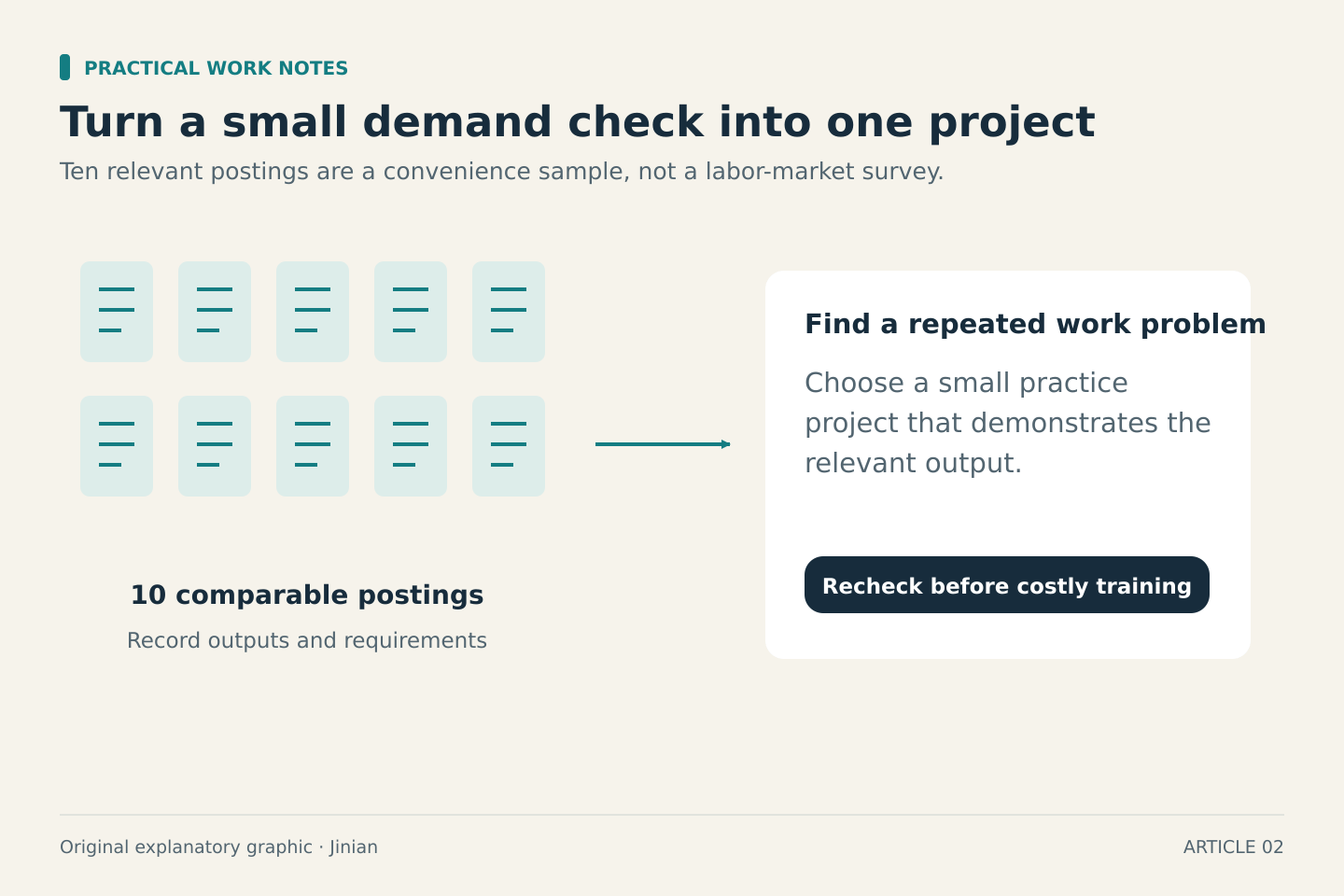
Collect ten recent, relevant job advertisements from employers' own career pages. Freelancers can use public project briefs and their own authorized client requirements instead. Keep the roles similar enough to compare: mixing administrative support with senior machine-learning engineering produces a confusing picture.
Record the posting date, role, required output, named tools, and evidence the employer requests. Separate mandatory requirements from preferences. Look for repeated work problems, such as preparing accurate reports or coordinating projects, rather than counting every occurrence of “AI.”
Ten postings are a convenience sample, not a labor-market survey. Use them to choose a practice project, then check a fresh sample before making a costly training decision. If your target roles require a specific qualification, a portfolio exercise does not replace it.
Practice four observable capabilities
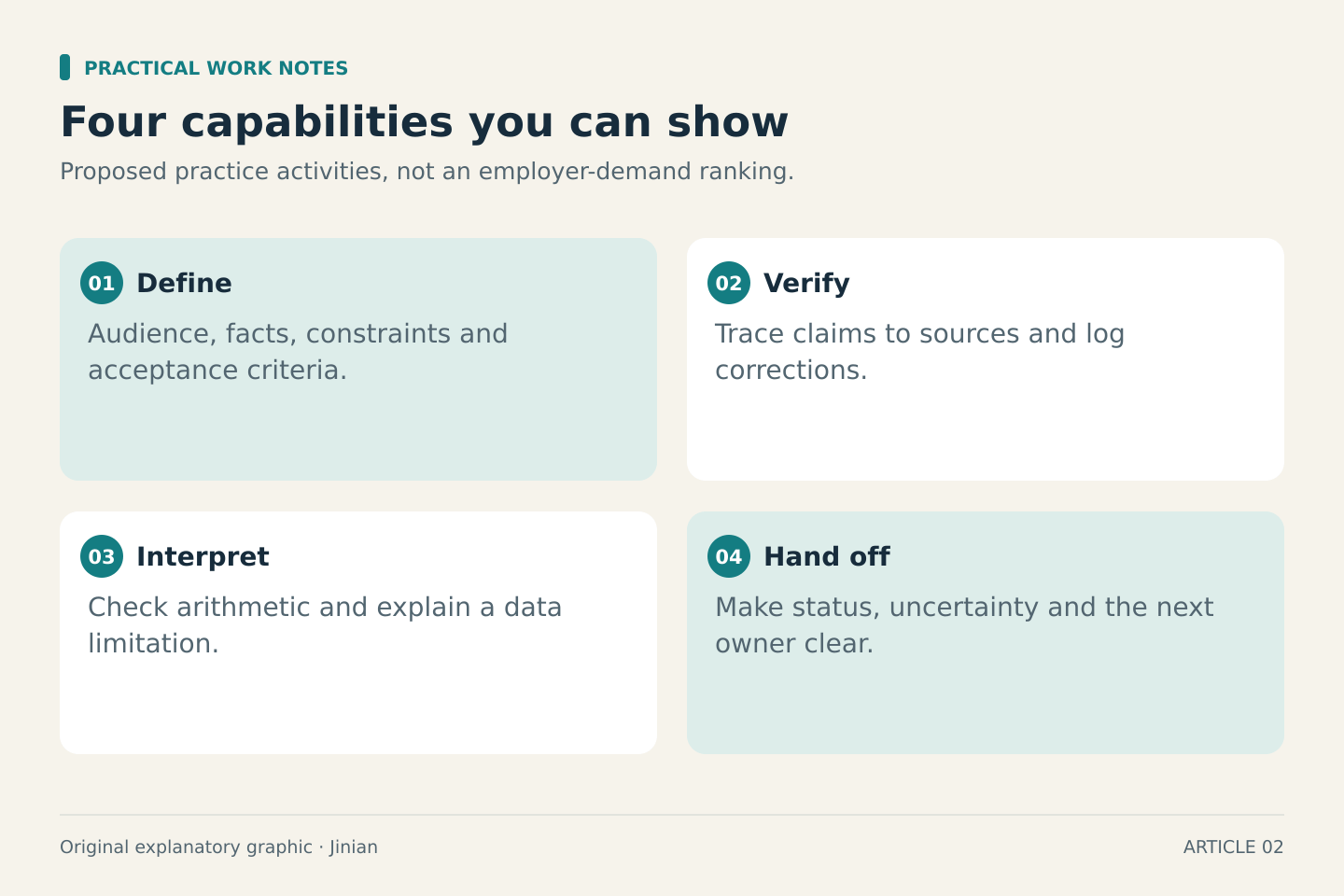
Define a task clearly. Write down the audience, purpose, supplied facts, constraints, and acceptance criteria before opening a tool. For an update email, specify what changed, what decision is needed, and which commitments are already approved. This gives you something concrete against which to assess the result.
Verify an output. Select a public document and create a short summary. Trace every factual sentence back to the document. Mark unsupported claims, missing caveats, and incorrect numbers. Save the corrected version alongside a short error log. The useful skill is explaining why an answer is acceptable.
Interpret basic data. Use a small fictional dataset to calculate a total, an average, and a percentage change in a spreadsheet. Check the arithmetic independently. Then explain one limitation, such as missing observations or a denominator that changed. Ask an AI assistant for an explanation only if you can validate its answer.
Manage a handoff. Create a brief that tells another person what is finished, what remains uncertain, where the source material is, and who must approve the next step. Clear ownership matters when generated material moves between people.
These are proposed practice activities, not a ranking derived from employer surveys. Choose the one most relevant to the demand check you just completed.
Build one useful work sample
Imagine you want project-coordination work. Create a fictional project with a delayed delivery, a dependency, and a decision awaiting approval. Label everything as a simulation, including any names and figures.
Prepare a one-page status update manually. If you already have access to an approved AI assistant, ask it to reorganize your supplied notes into the same format. Do not buy a tool for this exercise. Without suitable access, you can still practice the brief, checks, and handoff; simply do not label the sample AI-assisted.
Review both versions using the same questions:
- Does every date match the source notes?
- Are confirmed facts separated from assumptions?
- Has a suggestion been turned into an unapproved promise?
- Is the next decision understandable to someone joining the project today?
- Did the draft omit an important dependency?
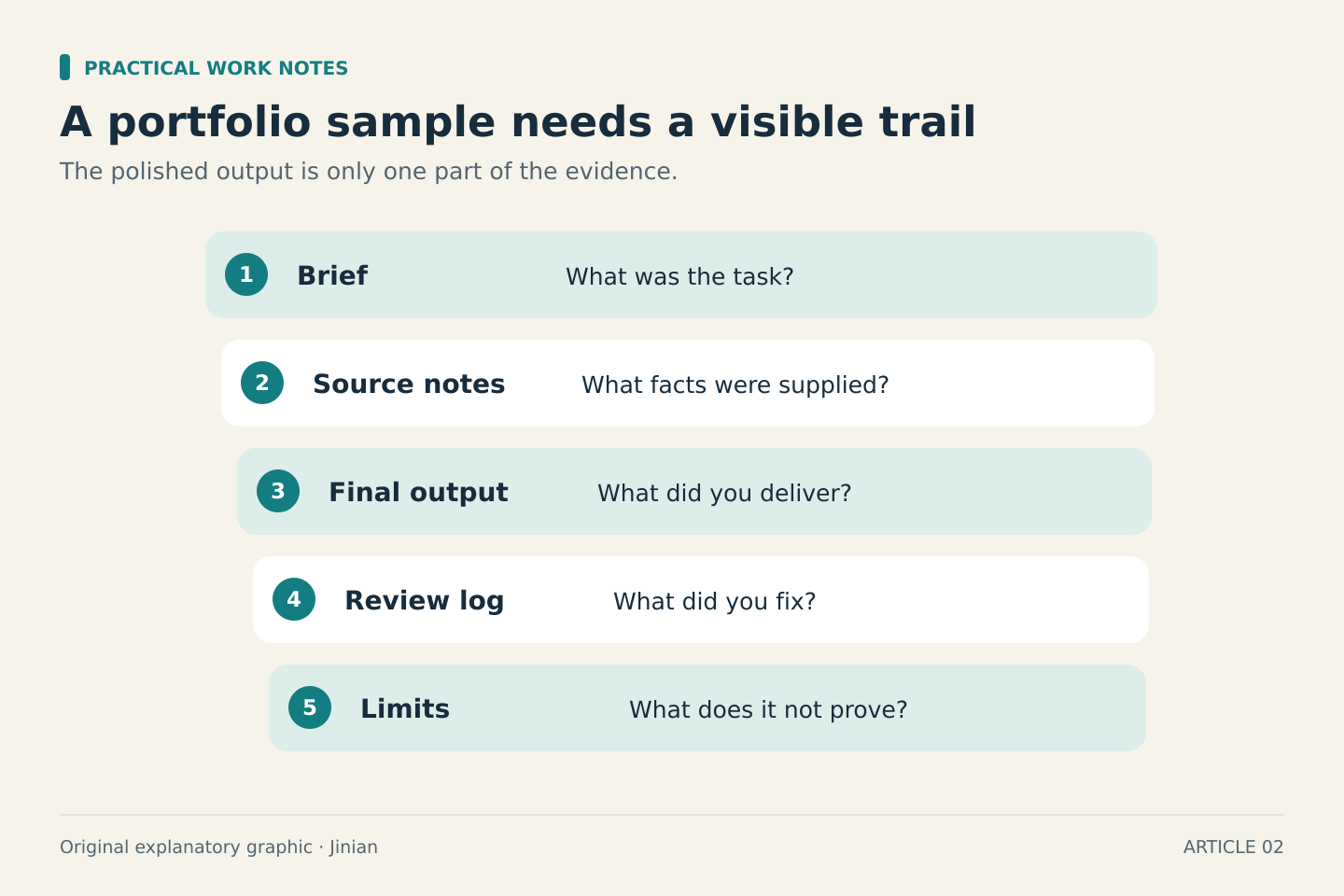
Keep the best final version and a short explanation of the revisions. A modest sample with visible corrections is more informative than an unexplained polished page.
Present evidence without inflating it
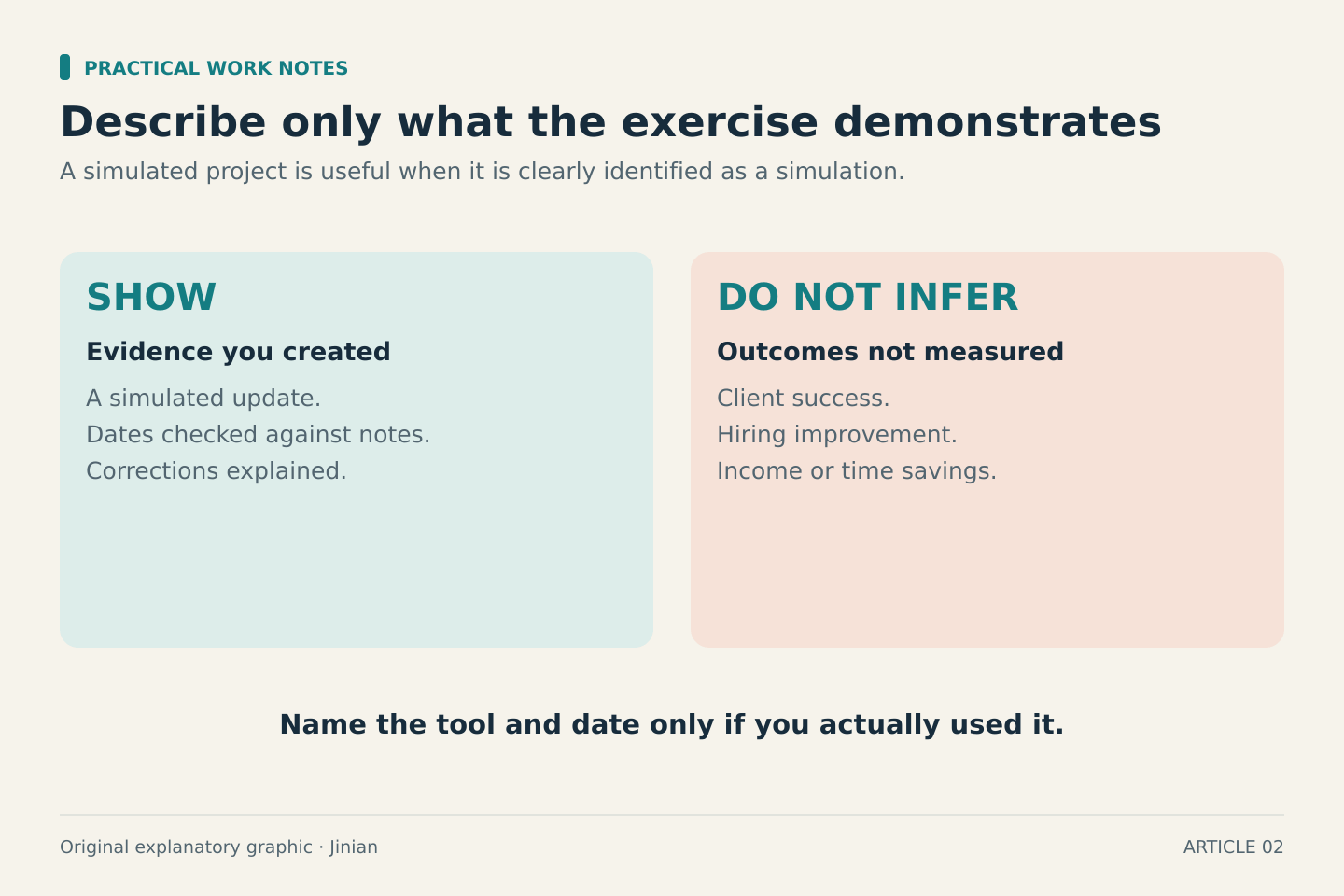
Your portfolio entry can include the brief, final output, review checklist, and limitations. Describe the tool and date if you used one, but do not make the brand the main achievement.
Use precise language: “Created a simulated project update and checked each date against the source notes.” Avoid claiming client results, professional experience, time savings, or revenue that the exercise did not demonstrate.
Repeat the exercise with a different problem before describing yourself as proficient. Practice once without AI too, so you can see what you understand independently. The aim is a demonstrable working capability that you can explain and improve. No short course or sample can guarantee a job, but a carefully chosen project gives your learning a practical direction.